TEXTS AND REFLECTIONS FROM BESS’S PRACTICE

I move here in the summer while everything is still open and embracing. The routine, which gathers the days together in a uniform pattern, I bring with me. Crocheted loops that continue into the next and form soft chains, which only resemble chains in the absence of their order, tangled together and impossible to see through. That’s how the days take shape. I follow him, as if he had been here longer than me. His swaying rhythm between the gravestones (many die in December, I note) while I trail behind like the appendage I am. I don’t know it yet at this point, in the scorching heat and the drowsiness that follows it, as if there were a gas leak and that, one could call it intoxication, that has also numbed me from moving back here. But as the town will open itself to me, so will its inhabitants, and their openness will become insistent, overwhelming, and crawling beneath the skin like an anthill, day by day. He doesn’t notice them, even though it’s him who seems to act as a kind of magnet. He doesn’t know that our rhythm is being scratched at, torn apart by the swarming words and glances, steps drawing closer. Eyes that drill and stick like the flies that slowly rotted on garlands of flypaper, that twisted and danced in the sun in her house during the summer. They don’t know that he is me, that he is an extension of my skin. Can’t they see it? The peach-like sheen too shy to absorb the sun, the softness that surprises people when they touch it. In the beginning it was as if the water waited for permission to seep into his strands of hair when we washed him; his entire exterior was like a water-repellent shell. Then it was as if the elements began to understand each other, to speak the same language.
Little by little, the lapping of the sun becomes heartbeats felt in the throat. A loose spring between the stomach and the tonsils, right where it hurts a little when you pronounce words with r, libra.
I’ve begun conducting experiments on repellency in outer layers. Methodically building a system of how to manage my material skin in a way that would seem repellent. A number from 1-10 is given based on an item or a full silhouette’s performance over the course of a day (approximately 3 walks).
Thin transparent blouse in a nude colour with grey roses, which can be mistaken for tattoos when they come into contact with the skin on my arms. Combined with a kind of vest: 2
I found it in the attic. My sister must have left it there. My claiming it feels emblematic of the shameful transformation that has taken place, and this disarmed state seems to glimmer through when I walk with it among the tall fir trees. I was seen by my family’s GP in his old, cool office. It was that age when your parents’ gaze on your body is suddenly taken over by your own. A gaze handed down to you, something that you tremblingly receive and must learn to take responsibility for. One evening in my room, I discovered them scattered across my back, my stomach, my arms. He gave them a name that sounded like a flower (something with “rose”). His immediate conclusion made the sceptical younger version of me not truly believe he was telling me the truth, cause as a child you can never really be sure. He prescribed some kind of cream that was to be applied. Later in my room, I would speculate about the correlation and think of it as self-inflicted somehow. As if the words from my thoughts had escaped from the incubator of my mind and died upon reaching the epidermis. Dried out in the daylight, leaving their remains exposed for the representative of the rational world to decipher. They would live their own life, return when it was most inconvenient, open cracks in my composed self whispering my inner shortcomings to strangers, shadows cast by inner shame.
Neon green veil: 6
This is actually a piece of fabric, but after being quickly cut and put on, it has now become a real garment, and it shall never be anything else. Bacteria veil my mouth, a signal that I am mute, that to break this silence would unleash contamination. People are deterred by the possible danger of the unknown, by what resists deciphering.
Sunglasses with exposed lenses and a partial frame that coils around them like wet tree roots: 10
They close around the face and turn into a large windshield where insects choose their own fate, as they stare at themselves and their death in the reflection of the sky. The uniform surface of the lenses seals around me like a glass sarcophagus. A girl I met the other day told me that the roots of cemetery trees reach toward the buried bodies. Underground, they appear like entwined fingers, embracing. I’m told that I smile too much, that’s the problem. Not my mouth, but my entire outer layer. Maybe it’s not just the openness of my face, but my whole feminine openness. One I haven’t chosen and can’t shut off. I’m merely a host for its power, powerless to decide who is invited in.
Black scarf that I just found in a French vintage shop: 5
It’s promising with its spider-like open threads, dancing like naked branches in the autumn wind. I recently learned that tarantulas, as they grow, shed their entire outer selves. Their worn garments become hairy tapestries like those hung carefully on lines strung between buildings. Molted from the inner cells of the houses, the stiff exoskeletons were beaten clean by old grandmothers until the dust disappeared into the low afternoon sun, dissolving into the words exchanged between the blocks. We were not welcome here, my father and I. We had strayed into this place; suddenly the streets closed around us, and we could only observe the rhythm of days so distant from our own. The tarantula’s old exoskeleton splits carefully along the back, and the animal emerges gradually, delicate and vulnerable, its new body soft and pale, yet already rigid in shape. Its legs unfold one by one, splayed like fragile branches, and it pauses repeatedly as if testing its new skin against the world. Some people have uploaded videos to YouTube where the speed has been increased, so it looks as if the unveiling happens over just a few minutes. A very fast, mechanical dance that looks like a struggle between the inner selves. In reality, it’s a slow process that takes many hours. One might be tempted to think this piece would score high, but because of the transparency between its woven details, it acts more like an opening, like the tarantula in real time. Lying on its back, open and exposed.
New wool coat, long, dark, soft with gigantic shoulders: 10
When it arrives in the mail, I rip the label off so this compulsive act from my subconscious instantly becomes irreversible. One could almost excuse this erratic act as a form of self-care, preparation for the long dark hibernation waiting ahead. Feeling like a woman, looking like a man. The shoulders are domes, small habitats on an uninhabited planet. Inuit tribes would have made this out of reindeer hide, distorted scapulas like a great mythic beast, with dancing tassels, a domed hood and domed ankles where offspring and provisions could be hidden from enemies and simultaneously protected during migrations in blizzards. I want to hide him in the domes, make him small so his magnetic power is shielded and kept intact.
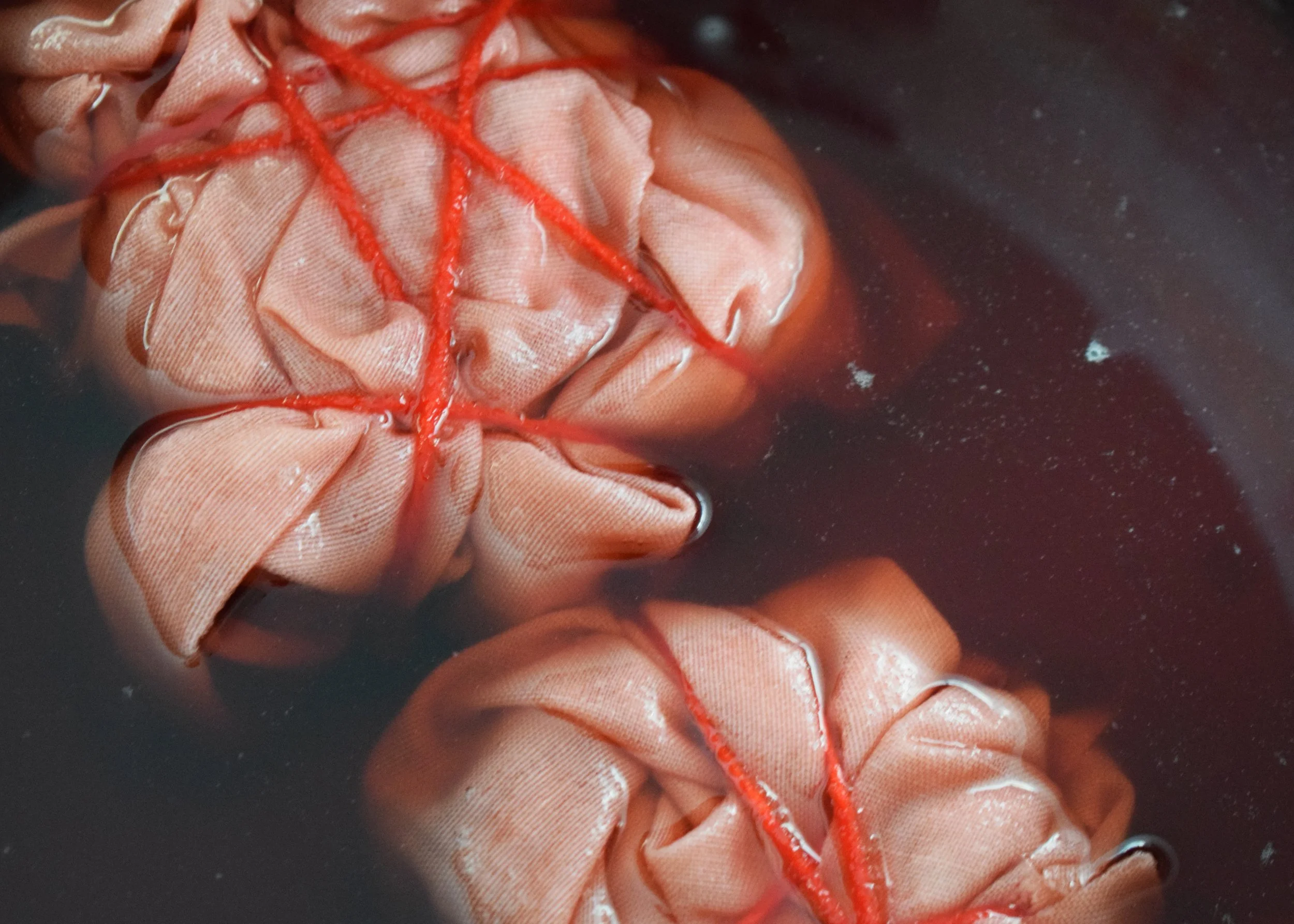
Turmeric, Skin, and Marigold
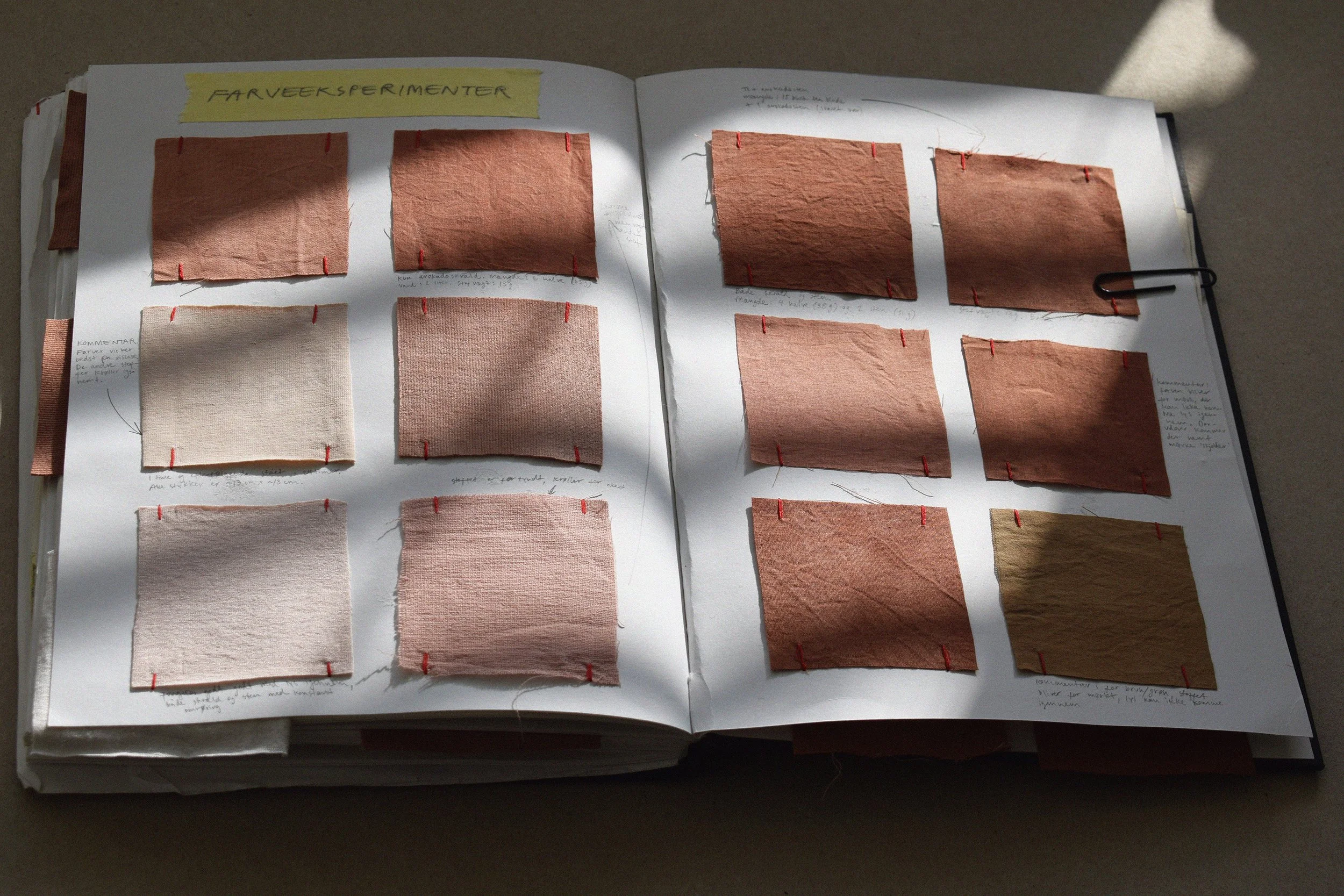
Some years ago, during an archive visit, I came across a small book. Half-hidden among other, more conspicuous objects, it could easily have been overlooked. Wearing the obligatory white cotton archival gloves, which served as a membrane between the present and the past, I carefully opened the book. As I flipped through the pages, my eyes scanned the delicate handwriting sporadically scattered among pieces of fabric. I interpreted the notes as instructions that had no intention of presenting themselves to a viewer. These were instructions written to track thoughts and enable replication of a potentially successful outcome. Experiments, they were.
As tangible proof of all these trials, squares of fabric were meticulously glued onto the pages alongside the written notes. Like small artworks with titles next to them, each page featured a piece of unfolded fabric next to a sample showing how it should be folded. The folded pieces resembled long cocoons holding onto something that was in the process of becoming. One page showcased a shifting emerald green and blue piece of fabric with numerous naked, undyed details from the creases of the fabric. Another page featured a fabric piece with a large round shape that resembled a halved beetroot with blood spurting out. There were turmeric-yellow shades and delicate pinks. Lightness, indifference, chaos, sensitivity, anger, fear, happiness, grief interwoven through the fibres of the pages. It felt incredibly personal to look at, as if they were diary entries never meant to be separated from their owner.
Some objects encountered in museums and displays seem more connected to their former lives than others.
Is it the physical evidence—impressions in the form of scratches, bumps, indentations, stretches and contamination from a series of actions in a lived life—that perpetuate life in an object? Like a mould forged by moving limbs and intermittent encounters with other objects, reflecting the lived experience. The American sociologist Harvey Molotch describes products as “a kind of prosthesis of our own minds.” Drawing on this notion, one could also ask if there is something more undefinable that resonates with parts of ourselves. Something that, like a mirror, puts us in contact with a potential past self, as is the case with so many other aspects of our lives.
As I enchantingly flipped through the pages, the archivist added some details in the background. I learned that the woman who had made this book was Anne Maile. She had moved to London with her husband in the 1960s from a small village in the East Midlands of England. She had children, and when they no longer needed her attention at home during their school days, she began experimenting in her kitchen with ingredients from her garden. She explored different colours and tie-dye techniques. Throughout the experiments documented in the book, you can see how she became increasingly methodical and advanced in her techniques. There were almost no books on tie-dyeing at that time, so she invented her own patterns and systems.
She might have started experimenting as a sole practitioner, but her work was an expression of the emergence of a broader movement in design at that time.
The 1970s was a pivotal decade for the design profession, marked by a significant shift towards more socially responsible, critical, and ecologically conscious approaches.
Designers began to recognise the broader societal and environmental impacts of their work and started to incorporate principles of inclusivity, sustainability, and community engagement into their design practices. It was also during this time that thoughts on self-sufficiency and DIY became prominent.
Natural dyeing stands in contrast to modern, industrial practices of product manufacturing, where the goal is to create standardised products that can easily be scaled in quantity. In these instances, designers often rely on machines, creating a separation between the maker and the product. With natural dyeing, no two outcomes are ever the same. While one may attempt to keep detailed notes and instructions to replicate a specific combination, it is impossible to achieve complete consistency. Ultimately, everything is determined by the natural processes, cells, tannins, and fibres of the plants, each possessing its own unique fingerprint. As humans, there is something intriguing about the impossible—an intrinsic, inherited urge to control and overpower nature, whether in the process of dyeing a piece of fabric or on a larger scale. Simultaneously, there is great satisfaction and a strange feeling of disarmament in accepting the uncontrollable and the potentially unpredictable outcomes.
In line with the aesthetic trends of the time, she experimented with all kinds of dream-like, abstract patterns—complicated designs that evoke thoughts of nature's ever-changing forms or the many acid trips that took place during this period. Common to these patterns was their hypnotic effect on the viewer, making one unsure of what one was actually looking at: the swaying wheat fields surrounding my childhood village, merging with the sky, the animals, the roads, the people, the dust, and the sweet scent of rain. One could get lost in these patterns, as everything seemed to merge and embrace one another.
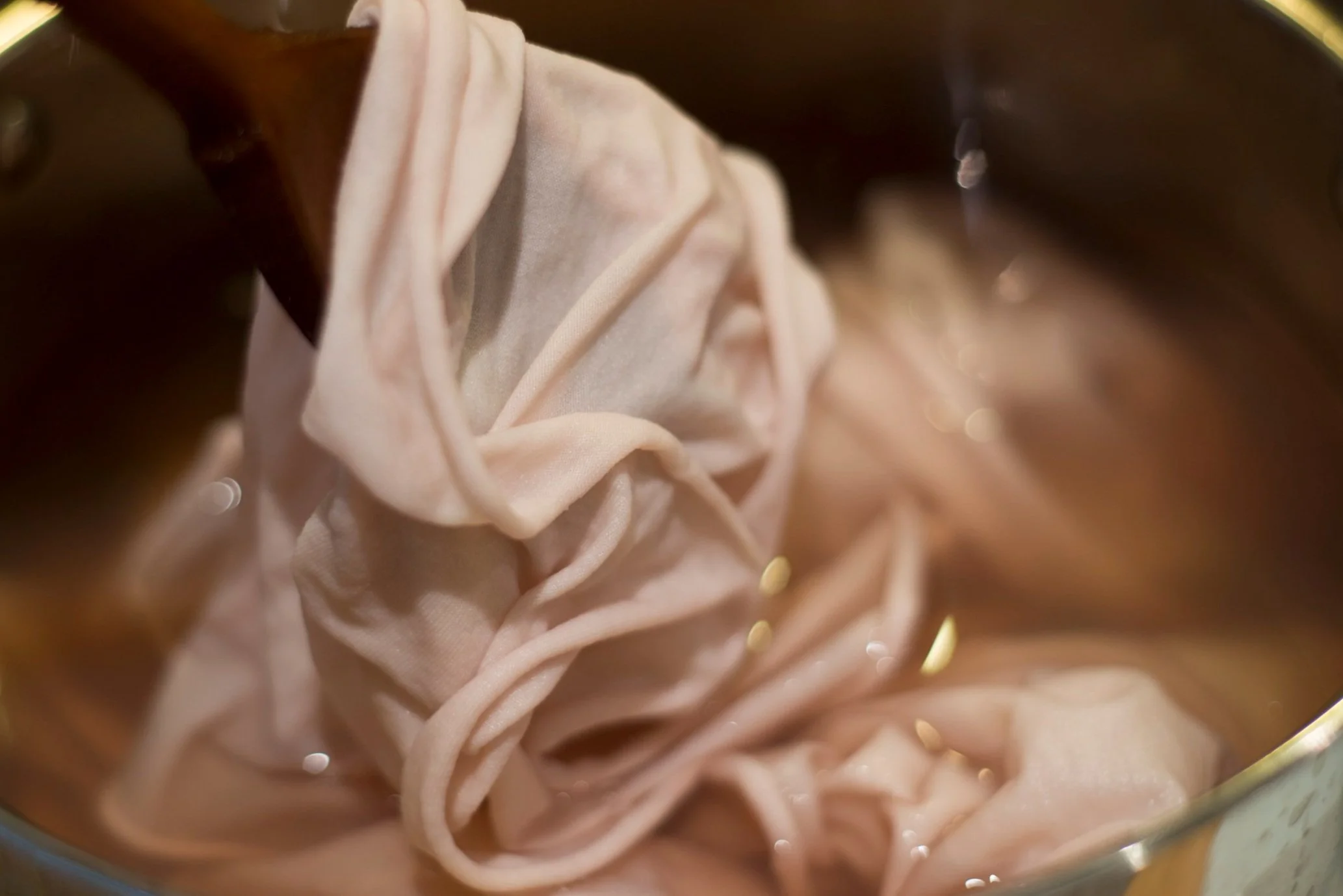
I began dyeing my own textiles a few years ago. My motivation came from various angles: aesthetically, I had certain colours in mind that I believed would complement the shape and material language of my designs. Functionally, I couldn't find any material and colour combinations that satisfied my vision for the light I wanted to emit through my lamps. From a principled standpoint, I didn't want to create a product using prefabricated materials that could potentially harm the environment and the people involved in their production. Inspired by the book and its author, I began to delve into how I could experiment with various pigments derived from natural ingredients. Before starting, I had already set some constraints for myself: the pigment should come from a natural ingredient that was already a by-product. I began to sift through my compost bin to find materials that could yield some colour. Soon, without even realising it, I had created my own little experimental book, complete with various instructions and small clippings of the results.
On Design and Words
What you are reading now is the first post in my journal. You may be questioning the importance of having a journal on a page where design objects are showcased. Or you may wonder whether it's merely another effort to generate content (often produced by one of those prevalent AI bots) in an attempt to attract potential customers, leading them to believe there is more here than the anticipated generic product images.
I genuinely hope that this is not how this journal will be perceived. I hope this journal will add a sense of transparency to the process behind the objects I design—the material process as well as the immaterial process. In a world overrun with products, I believe that it’s more important than ever before to feel attached to the objects we choose to hold on to. So much that they will stay with us for a lifetime and more lifetimes to come.
As a designer, I’ve always felt that there was a disconnect between the written words and the tangible materiality of objects. What I was getting from one was lacking from the other, without ever complementing each other. From the moment we enter design universities, the two are treated like separate fields. In a way they are. Of the many sketching approaches we learned and familiarised ourselves with, writing was never one of them. Everything had to originate from materials to become something material. That was the logic, I suppose. I was always struggling with the sketching part, always feeling constrained, not able to shut out my thoughts and surrender myself to the ephemeral nature and the separate life of the morphing shapes. I spent years figuring out the right approach for creating—perhaps because I had not yet identified this disconnect within myself. At times I would wonder if design was even the right field for me. Over time I’ve come to see and understand the connectedness and interdependence of the two worlds, the written and the material, and the profound, intricate bond they hold in me.
I will not pretend to be the first one to draw a connection between language and design. Numerous scholars have extensively analysed the language and sign systems of objects, spanning from Roland Barthes to Jean Baudrillard. However, design is and has often been studied from the perspective of the consumer, society or even the object itself; how we use our belongings as signifiers, how they form a non verbal language that help us navigate the social world, and how certain objects may be seen as having their own form of life or consciousness. In this post I would like to flip the perspective and write from my own experience. As a storyteller, as a problem solver, as a designer.
I’ve always been drawn to and needed systems. Very clear structures and definitions of the world surrounding me. If there is no clear system, it’s as if everything just melts together and becomes indiscernible, at times even frightening and overwhelming. Something that is not defined can potentially be anything. Whenever the world seems unclear, all mashed and difficult to navigate, I’ll write all my thoughts down in my little red notebook. A good old method that always offers a cathartic release. It was not until I read Victor Papanek’s ‘Design for the Real World’ that I was able to connect the two processes, boiled down to one sentence: “Design is the conscious and intuitive effort to impose meaningful order.” In other words, design is a way of creating order in the world.
I realised that the same sense of release happened when I ‘solved’ a problem with an object that was in the process of becoming and had not yet found its final shape. The ‘release’ that comes from the design process is the outcome of a process that starts with identifying a problem. The nature of the problem can vary in complexity or significance from “I need a better reading light” to more weighty issues. Whatever the problem might be, there is a long phase following the identification of the problem to the object finding its final shape.
Chaos unfolds. Fleeting meanings and potentials, combinations and messages. A tightrope wire suspended between the roofs of two skyscrapers and spectators waiting in the streets in awe. Which shape is right for this object? What materials, what textures, what tactility does it call for? There is a nagging, almost painful uneasiness from the moment you know what functional solution is needed to the moment when the object falls into place with its predestined form expression. A disturbance coming from the disorder. Nothing is fused together, every little potential part is choppy and inflexible, and has no connection with the other parts. Something just isn't right. Is there a right and a wrong at this stage?
A scaffold or a railing is needed to hold everything in place and help the users and spectators not lose balance. The words, once leaving the tip of the pen, are reacquainted with each other. Children taking seats on the long wooden school benches after a long summer break. There is a flexibility in the written word that is not found in the material world. Words create a material reality in the mind. How to channel this potential into the object is the role of the designer.